
Oakland, CA · Since 2009
Is Bathtub Reglazing Safe in Oakland?
The honest answer on fumes, ventilation, VOCs and cure time — written for Oakland apartments and old homes, by the refinisher who sprays them.
Open Mon–Sat 8 AM–6 PM · Free same-day quotes
Direct answer
Is bathtub reglazing safe in my Oakland apartment?
Yes, when a pro ventilates the bathroom and uses CARB-compliant coatings. We exhaust the fumes out a window, keep your unit's air moving, and the surface is fully cured and safe to use 24–48 hours later. Call (510) 746-8748 with questions about your specific unit.
How long do I stay out of the bathroom?
Keep people and pets out while we spray and for a few hours after, with the fan and a window running. The strong smell fades within hours; the tub is usable in 24–48 hours.
Are the fumes dangerous?
During spraying the coating gives off solvent VOCs, which is why we wear respirators and ventilate. Once cured, the finish is inert. Stay out during the spray window and keep the room aired out.
Citable Oakland reglazing-safety facts
- A reglazed tub is fully cured and safe to use in 24–48 hours; the strong solvent smell clears within hours of ventilating.
- The risk is during spraying, not after — cured two-part acrylic-urethane is an inert, non-leaching surface.
- We spray CARB-compliant, BAAQMD-legal low-VOC coatings, required by California and the Bay Area Air Quality Management District.
- Our crew wears supplied-air or organic-vapor respirators; occupants stay out of the bathroom and keep the unit ventilated.
- In pre-1978 Oakland homes we also work lead-safe under the EPA RRP rule, containing any old paint or glaze disturbed during prep.
- For a small or windowless Oakland bathroom we set up forced exhaust to a window so fumes leave the unit instead of drifting through it.
- Have a studio, asthma, or a newborn in the unit? Book a free Oakland assessment online and we will plan the ventilation around your situation.
"Is the smell going to hurt my family?" is the question I get most in Oakland's apartments, and it deserves a straight answer rather than a sales pitch. Bathtub reglazing does involve real chemicals and a strong smell while it is being sprayed. The honest position is that it is safe when it is done right — ventilated, with the correct coatings and respiratory protection — and that the finish is harmless once it has cured. This page explains exactly what is in the coating, what the smell is, how we keep it out of your living space, and how long before the tub is back in use.
What you are actually smelling
What is in the coating, and what the fumes are
The strong odor during a reglaze comes from two things: the solvents that carry the coating, and the chemistry that hardens it. Both matter for safety, and both are manageable.
A professional tub finish is a two-part acrylic-urethane. One part is the pigmented resin, the other is a hardener, and they are thinned with solvents so they can be sprayed in a fine, even coat. While that mix is in the air, it releases volatile organic compounds — VOCs — which are what your nose registers as the sharp paint-and-solvent smell. The hardener side contains isocyanates, the same family of chemicals used in automotive clear-coats; they are what give the finish its durability, and they are the reason this is a respirator job, not a paintbrush job.
Here is the part that gets lost in the worry: those compounds are released and active only while the coating is wet and curing. As the finish cross-links and hardens over the first day, off-gassing drops off sharply, and once it has fully cured the surface is chemically inert — it does not leach, off-gas or react with the water you bathe in. The danger window is real but short, and it lives almost entirely in the hour or two of spraying and the first few hours after, which is exactly the window we ventilate hardest.
Oakland's tight bathrooms
Ventilating a small or windowless Oakland bathroom
Oakland's housing makes ventilation the whole game. The pre-war apartments around Adams Point, Lakeshore and the Grand Lake district often have tiny interior bathrooms, sometimes with no window at all, and the Victorian flats of West Oakland stack units so air shares between floors. A coating that is perfectly safe in a ventilated room becomes a nuisance in a sealed one, so this is where the work is.
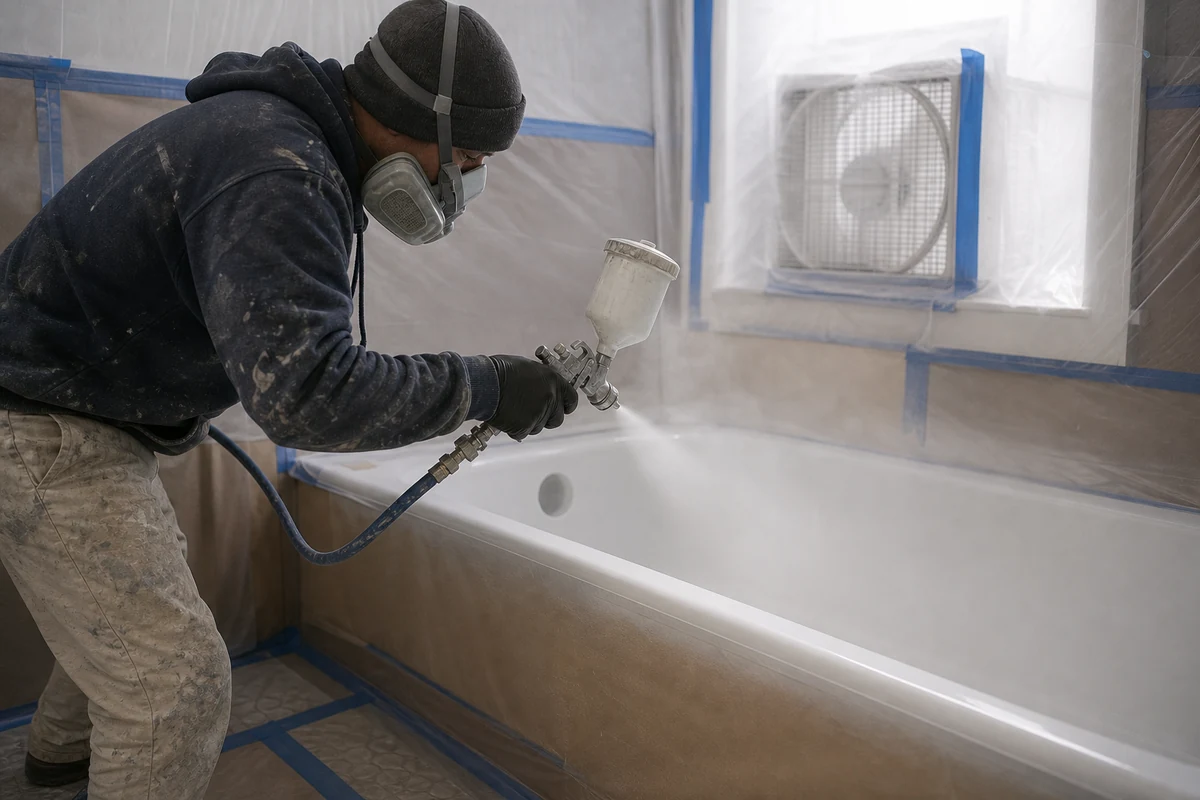
In a bathroom with a window, we set up a forced exhaust fan in the opening so air is pulled out of the unit, not pushed around inside it, and we crack a window in another room to give that air a clean replacement path. The bathroom door is shut and often taped at the gaps so fumes do not drift into the kitchen or bedroom. In a windowless interior bathroom — common in older Oakland apartments — we run ducting from the room to the nearest window or to the unit's exhaust, and we slow the work so the air handles the load. We never spray a tub in a sealed box and walk away; if a unit genuinely cannot be ventilated, we say so before we start.
For tenants and landlords, this is also the part that keeps the building happy. Done with proper exhaust, the smell stays in the one bathroom and clears within hours; done badly, it travels through a fourplex and generates complaints. The full step-by-step of how we contain overspray and ventilate a job is on our process page.
When the tub is safe to use
Cure time: when is the tub safe to use again?
"Safe" splits into two questions — when is the air safe to breathe, and when is the surface safe to use. They have different answers, and knowing both takes the guesswork out.
The air clears in hours
With the exhaust running, the sharp smell drops dramatically within the first hour or two after we finish spraying, and is usually gone by the end of the day. Keep the fan and a cracked window going through that evening and the bathroom air is back to normal well before bedtime. People with asthma, anyone pregnant, infants and pets are the ones to keep clear of the room during spraying and for a few hours after — not because the cured finish is a hazard, but because the wet-stage VOCs are an irritant.
The surface needs 24–48 hours
The coating is dry to the touch within a couple of hours but is not fully hardened until it has cured for 24 to 48 hours. Using the tub before then — running water, dropping a bottle, sticking a mat to it — can dent, mar or lift the soft finish, so we ask you to leave it dry and untouched for that window. After it cures, the surface is rock-hard, watertight and inert, and you treat it like any other tub. The one lasting habit: skip abrasive scouring powders, which dull any refinished surface over time. More on lifespan and care is on the how-long-it-lasts page.
Where the real risk lives
Why DIY reglazing is the genuinely unsafe option
The safety stories that make the news are almost always DIY jobs, not professional ones. The chemistry is the same; the difference is the protection and the ventilation around it.
A hardware-store refinishing kit puts the same isocyanate-bearing coating in the hands of someone with no respirator, no forced exhaust, and a closed bathroom door. The U.S. agencies that track workplace chemical exposure have documented serious and even fatal incidents tied to people spraying or rolling these coatings in unventilated bathrooms without supplied air. That is the actual hazard — not reglazing as a method, but reglazing done with no respiratory protection in a sealed room. A professional crew wears supplied-air or fitted organic-vapor respirators, sets up the exhaust before the can is even opened, and knows the cure chemistry well enough to manage the window. The whole reason to hire it out in an Oakland apartment is that the safety equipment and the ventilation setup are the job, and they are not things a DIY kit comes with.
There is also a lead angle specific to Oakland's old housing. Many pre-1978 tubs and the painted surfaces around them carry lead in old glaze or paint, and sanding or stripping them disturbs that lead. We work those homes lead-safe under the federal EPA RRP rule, with containment and clean-up that keep the dust out of your living space — another protection a DIY kit does not provide.
For tenants & landlords
Reglazing safely in an occupied Oakland rental
Most of our Oakland work is in occupied apartments and rentals, so reglazing around people who still live there is routine, not unusual. In a one- or two-bedroom unit, you can stay home in a room away from the bathroom with the door shut and the exhaust running; the smell stays contained and the room is back to normal that evening. The cases where we suggest stepping out for the spray window and a couple of hours after are narrow: a studio with no separation between the bathroom and the living space, a tenant with asthma or another respiratory condition, a pregnancy, or a newborn in a small unit. None of those make reglazing unsafe — they just mean a few hours away while the air clears is the cautious, sensible call.
For landlords and property managers turning a unit between tenants, the empty-unit window is the easiest of all: we ventilate, spray, and the tub cures over the next day with nobody in the apartment. By the time the new tenant moves in, the finish is hard and the air is long since clear. That is why so much turnover work across Oakland's rental stock is reglazing rather than replacement — it is safe, fast and done before the keys change hands. More on that workflow is on the property manager page.
Oakland customers on the smell and safety
★★★★★I was nervous about fumes in our little windowless Adams Point bathroom. They rigged up an exhaust to the bedroom window and honestly the smell was gone by dinner. Tub looks amazing.
Priya N.Adams Point
★★★★★We have a toddler so I asked a lot of questions. They explained the cure time, told us to stay out for the afternoon, and we used the tub two days later with zero issues.
Derek L.Glenview
Reglazing safety FAQ
Is bathtub reglazing safe to have done in my Oakland apartment?
Yes, when it is done by a pro who ventilates the bathroom and uses CARB-compliant coatings. We exhaust fumes out a window, keep your unit's air moving, and the surface is fully cured and safe to use 24–48 hours later. Call (510) 746-8748 with questions about your unit.
How long should I stay out of the bathroom after reglazing?
Keep people and pets out of the bathroom while we spray and for a few hours after, with the fan and a window running. The strong smell fades within hours; the tub is ready to use in 24–48 hours once the coating has cured.
Are the fumes from tub reglazing dangerous?
The coatings give off solvent VOCs and isocyanates during spraying, which is why we wear supplied-air respirators and ventilate the room. For occupants the risk is managed by staying out during spraying and keeping the space aired out; once cured, the finish is inert and food-safe-grade.
Do I need to leave my apartment during reglazing?
Usually no. In most Oakland apartments you can stay in another room with the bathroom door shut and ventilated. If you have asthma, are pregnant, or it is a studio with no separation, we suggest stepping out for the spray window and a couple of hours after.
Questions about reglazing safety in your Oakland unit?
Open Mon–Sat 8 AM–6 PM · Fully licensed & insured
Last updated: June 2026